
Complete Guide to Generative AI in eCommerce 2026
Gopesh Verma
Key Takeaways
- GenAI helps manage product discovery, automate repetitive tasks, personalize interactions, support service teams, and more across the digital economy.
- The 2026 analysis by Adobe states that US retail websites have an increase of 393% in traffic from AI source recommendations from Jan-March.
- Early adopters of generative AI in their regular operations gain significant operational and ROI advantages.
- Conversational AI, a subset of Gen AI, helps handle risks and manage other retail tasks very easily.
- eCommerce GenAI is expanding the opportunities of traditional commerce with integration, development, and accountability.
Artificial intelligence is changing the way people shop by making checkout and purchase of products a simpler task. Conversing with shopping assistants, getting suggestions tailored to each person, and having product displays are all part of a set of systems that online stores are now using because of generative AI.
Even though the future looks good, it is one thing to use these systems and another thing to bring them into the business. Based on the results of the Stord report, 89% of stores are using AI, but only 7% have put it to use in a big way. It is clear that doing well depends on how well companies can put AI technology to work.
With a trusted generative AI service provider, you can explore how it provides value in the e-commerce sector, its use cases, advantages and complexities, and the future scope. Read through this guide to find what really matters now and how the retail industry is getting reshaped with AI.
How is Generative AI in eCommerce Significant for Enterprises?
GenAI in eCommerce relates to the application of AI technology for the purposes of producing, summarizing, tailoring, or modifying information. The aim is to improve online shopping as well as retail processes with the help of technologies that can produce texts describing various products, create advertising, compile reviews, respond to customers’ questions, and give them recommendations about suitable goods.
As compared to traditional AI, which implies some predictive abilities and recognition of patterns and is used for prediction tasks, generative AI creates information with use of techniques such as generative adversarial networks (GANs) and natural language processing (NLP), holds significant importance for both businesses and consumers alike. Agentic AI here employs it for completing multiple tasks simultaneously in connected systems with given authorizations.
As indicated in research carried out by the National Retail Federation (NRF) and IBM in January 2026 among 18,000 consumers from different countries, 41% of users use AI assistants to conduct product research, whereas 33% rely on them to get reviews and 31% use these services to find discounts.
Organizations have opportunities to generate multilingual content, improve customer support, learn from customer feedback, and automate dull activities. In order to benefit from these, business owners need to have the proper data, integration between the systems involved, people who would be watching the process, and proper handling of customer information.
It is evident that generative AI is not just about content production anymore, but it is also giving a hint of the part it will play in helping retailers to assist their clients in reaching their aims.
12 Strategic Use Cases of Generative AI in eCommerce
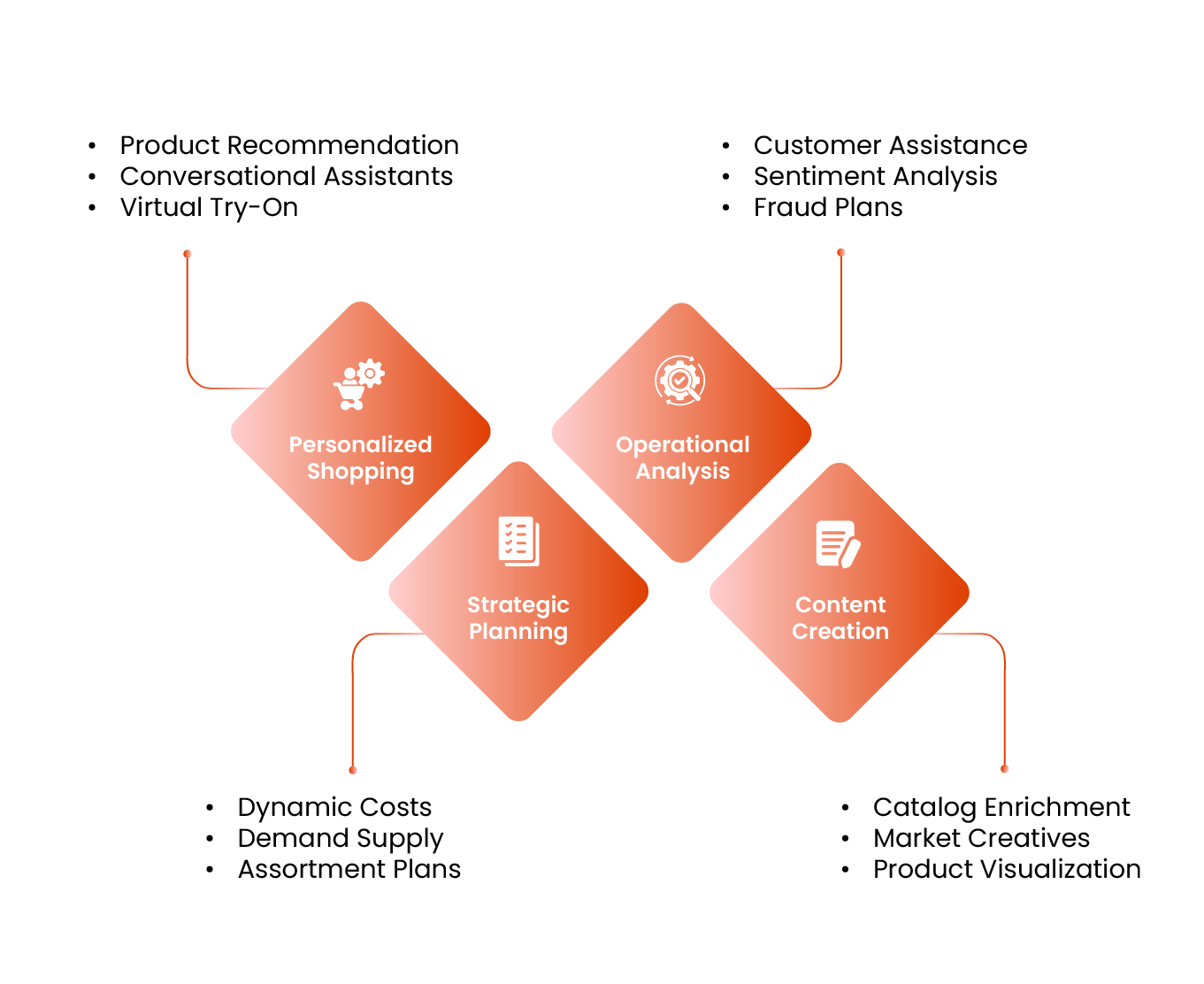
The role of generative AI in shopping is to assist businesses in discovering their products, generating content, personalizing the customer experience, and improving business process efficiency. Below are some of the examples of how retailers can use GenAI to address their day-to-day business needs.
1. AI for Personalized Product Discovery
Generative AI offers personalized product suggestions to customers. It looks at what they like, what they have browsed, bought, and other details about the products. It explains why a customer might need an item, suggests other items that go with it, and gives special details about the products.
For instance, an online electronics store can recommend laptops to customers. These suggestions are based on what the customers need, what features they want, how they plan to use the laptops, what their budget is, and so on.
Enterprise Benefit: Relevant products, more customer interaction, and possibly better sales with bigger orders.
2. AI-Powered Product and Catalog Optimization
GenAI creates product titles, descriptions, FAQs, and other content. It uses product data and follows brand guidelines to adjust content to fit languages, markets, countries, and similar customer preferences.
For instance, a fashion retailer can write descriptions for thousands of products altogether with generative AI technology using information about materials, sizes, colors, and how to store or secure the items.
Enterprise Benefit: Continuous automated updates to product catalogs with the latest information and reduced human effort.
3. Automated Product Visuals and eCommerce Marketing
This technology helps teams create content for campaigns, including visual representations of products, pictures of how items fit in everyday life, various options of how the product looks in the background, and other preparatory materials for advertising campaigns. Human supervision is needed to make sure the images correspond to the real product.
For instance, a furniture shop can create an advertising campaign showing how one specific couch fits into different homes without clicking multiple pictures.
Enterprise Benefit: Speed and less effort spent on product image creation and visualization for more customer engagement and higher sales.
4. Conversational AI for Intelligent Shopping Experiences
AI-powered shopping assistants allow customers to ask questions regarding a product using natural language and compare them by their specifications and features, as well as get personalized recommendations. They can also perform real-time inventory checks and allow customers to fill their carts by integrating with reliable databases.
For instance, customers may ask for a wheeled suitcase fitting certain airline dimensions and have space for a laptop too.
Enterprise Benefit: More convenience for eCommerce customers and fewer steps while shopping online.
5. AI Customer Service and Post-Purchase Care
GenAI handles repetitive questions, summarizes customer calls, and writes support documents when needed. Simple queries can be managed by automated tools; however, when things get complex, human intervention is still required for ideal decision-making.
For instance, a customer service assistance system can tell users about the store’s return rules, check the delivery status of their order, and help with customer requests.
Enterprise Value: Rapid replies, fewer repetitive tasks, and more consistent customer service.
6. Smarter AI-Driven Product Discovery
Generative AI helps understand what shoppers really want when they search by studying and analyzing language, and figuring out the intent behind the search even when shoppers don’t know the exact product name.
For instance, browse for a ” waterproof riding jacket.” The AI finds items that match all those features, not just a keyword. That way shoppers get results that actually fit what they’re looking for.
Enterprise Value: More relevant search results, fewer unsuccessful searches, and a smoother shopping experience.
7. Campaign Development and Performance Checks
With GenAI, businesses can create marketing essentials, including emails, advertising, promotional material, product launches, and customized landing pages by region. It can also summarize results of your marketing activities, such as performance analysis of specific campaigns, which could help marketing teams evaluate new ideas.
For instance, an online store can create different marketing messages across regions and campaigns, in multiple languages. Even when doing so, they need to follow brand guidelines.
Enterprise Value: Quick message creation and campaign implementation with a personalized touch.
8. Automatic Customer Feedback and Sentiment Insights
Generative AI technology processes large quantities of data from product reviews, support requests, and other types of customer feedback. Consequently, it helps to reveal common problems customers face and their expectations.
For instance, countless user reviews can be analyzed together, which would provide information on issues such as weak battery life, difficulties with installation, and low durability.
Enterprise Value: Fast and simplified customer insights and informed product decisions for reliable marketing and eCommerce.
9. Interactive Virtual Try-On and Product Experiences
Generative AI integration with computer vision can be extremely useful for eCommerce retailers, as it allows them to see how products would look when they are about to be purchased. These applications include the possibility to try on clothes virtually, to check the shades of cosmetics, to visualize accessories, and even see how a piece of furniture would fit into a certain room.
For instance, a website selling beauty products may give consumers an opportunity to picture how a certain lipstick or mascara shade will style their look before a purchase is made.
Enterprise Value: Increased confidence in purchasing products. Thus, minimizing the chances of returning products that occur due to mismatched expectations.
10. Dynamic Costs and Promotion Strategies
Use GenAI for analyzing pricing data and making suggestions regarding promotion, as predictive models and optimization systems deal with demand, competition, inventory, and profit constraints in the existing and growing market.
For instance, a retailer can use AI to summarize products that might need to be promoted due to changing demand and surplus inventory and propose prices that have been verified against business rules.
Enterprise Value: Improved pricing, promotional activities, and profits both for retailers and consumers in the eCommerce market.
11. Warehousing, Demand and Supply Forecasts
GenAI helps predict, provide overviews of inventory issues, describe out-of-stock analysis, and suggest restocking activities. However, both prediction and inventory improvement rely on models and planning systems rather than on generative AI technology alone.
For instance, an AI system offers an overview of items that are likely to go out of stock based on the major promotional campaign, and prepares a corresponding replenishment proposal.
Enterprise Value: More effective workflow analysis, exception handling, and deciding inventory for e-commerce businesses.
12. Fraud Prevention, Innovation, and Merchandising
Generative AI supports the fraud department in summarizing suspicious transactions and preparing the materials for the investigation. It also assists the product and merchandising departments in analyzing the comments made by customers and developing product ideas. Nevertheless, fraud detection usually requires risk models and controls.
For instance, the company can use automation to summarize the recurring transaction irregularities for investigators and help the product specialists identify the features that should be developed for the customers.
Enterprise Value: Less time spent on manual analysis and more productive investigations without overspending or extra effort.
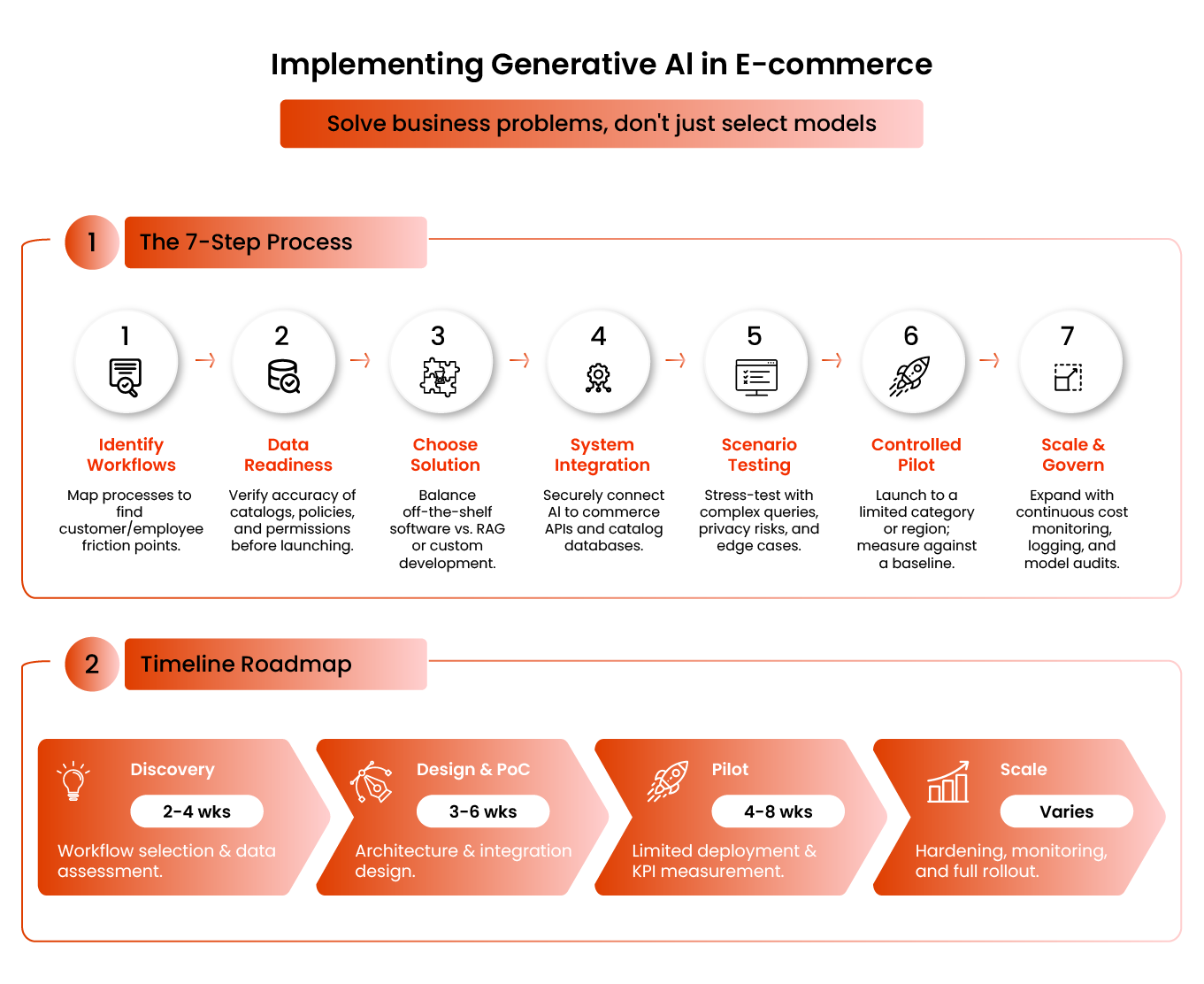
These cases are to represent how GenAI is actually incorporated with correct product data and established commerce infrastructure for increased product effectiveness and a streamlined shopping experience. To get the most value out of it, retailers must begin by identifying use cases that address specific business issues such as:
- Product data generation
- Customer shopping experience, or
- Customer support
However, efficient control and assurance of privacy measures are necessary in order to keep customers’ trust. Also, it is necessary to evaluate success using relevant criteria, such as:
- Data generation speed
- Conversion rate
- Customer satisfaction
- Time for resolving customers’ issues
- Number of products returned
- Errors in the inventory
Compare the outcomes with the baseline, and expand the successful use cases step by step for scalable business growth.
The BCS Triad of Generative AI in eCommerce
It is important to understand how business areas benefit, what issues they face, and how to fix them. The distinction table below gives a clear overview of the same:
| Key Area | Value Received | Complexities | Resolutions |
| Cost Optimization | Improved product searches and conversion | Misleading product recommendations to users | Gather responses in verified product datasets |
| Branding | Rapid campaigning and content generation | Inconsistency in branding and network issues | Review content and follow brand guidelines |
| Customer Satisfaction | Personalized support and experiences | Privacy threats and inappropriate answers | Secure customer data and validate query answers |
| Merchandise | Quick product listing | Inaccurate details of the items | Automate drafts correctly |
| Workflow | Reduced manual effort and speedy operations | Misuse of AI and complex data integration | Restrict permissions and connect systems |
| Customer Engagement | Relevant customer support post-purchase | Irrelevant communications and plans | Adapt content-based personalization |
| Quality | Quick feedbacks and analysis | Incorrect or irregular feedbacks | Track issues and verify insights |
| Compliance | Better productivity and scalability meeting governance | Increased costs and no clear assigned accountability | Set proper controls, assign ownership, and manage revenues |
To sum up, GenAI can enhance revenue, customer experience, and efficiency in the market, but with absolute data integrity, human oversight, sound regulations and governance, and optimal business results.
How Generative AI in eCommerce Functions For Large Businesses?
How GenAI Integrates Within Existing eCommerce Platforms?
Generative AI simply enhances and streamlines the operations of the existing platforms and does not replace them. It must be embedded into the eCommerce business as:
| Platform Layer | GenAI Role |
| Business Channel | Website, Applications, Marketplaces, and Consumer Portals |
| Artificial Intelligence | APIs, LLMs, RAG, AI Agents, Search and Recommendations |
| System Integration | Warehouses, PIM, DAM, CRM/CDP, ERP, Orders, and Payment Portals |
| Governance and Safety | Privacy, Controls, Validation, Monitoring, Quality, Audits, and Policies |
The core technologies mentioned above are for the use of:
- Multimodal AI and Large Language Models (LLMs) to understand customer queries and respond to them with text, images, or other supported media.
- Retrieval Augmented Generation (RAG) to store responses and update data with business information regularly.
- Application Programming Interface (APIs) and Agents to access item data, check availability, compare multiple options, and help in operations with proper permissions and access controls.
- AI Governance to evaluate accuracy, costs, failures, success, and latency, and consumer outcomes.
How Generative AI in eCommerce Reshapes the Future?
In eCommerce, the larger the volume of context, policies, customer engagements, etc., the greater the scope for opportunities. With advanced components of GenAI, operations move beyond simply generating content as follows:
- AI Agents: Using this, the business goes beyond making suggestions; it offers assistance during the process of finding products, making comparisons, and deciding to purchase items following the authorization procedure.
- Data Processing: Structured and well-made product information allows for a better search engine optimization process and makes it easy to find products through artificial intelligence technology.
- Multimodal AI: The provision of the possibility of finding products through multiple media such as text, audio, and images is an important aspect of this shopping technology.
- Privacy-First Personalization: GenAI can help enterprises come up with personalized recommendations for eCommerce customers while ensuring that their data is kept safe and used fairly.
- Governed AI: It allows one to manage processes and systems by implementing access-control measures along with logging of the activities and monitoring of the tasks done by the users.
Retailers should keep in mind the importance of having rigorous product information and an API-enabled technology in place for effective business growth in the near future.
How Xcelore Helps eCommerce Businesses With GenAI Services?
Our Generative AI development services in eCommerce help to create actionable outcomes as the organizations go from understanding the capability to building custom platforms and deploying it throughout the business to operate effectively.
We even provide an assortment of AI solutions from Exei for automating shopping, Xcelight for instant store monitoring, and the Valriz platform for controlling AI activity.
The key to using AI in eCommerce is starting with an effective process, gathering reliable data insights, and sufficient human supervision to build an ideal platform based on the outcomes obtained.
Frequently Asked Questions
Q. Should Gen AI be used for mid-sized eCommerce businesses or enterprises only?
A. Generative AI can be used easily by businesses of all sizes as well as enterprises too. Mid‑Sized retailers usually choose it for product descriptions, customer engagement, and catalog enrichment. When the business grows, they look for services that match their specific needs and goals.
Q. What should an eCommerce business do with Generative AI: build, buy, or blend?
A. Buying is very important for generic use cases. However, when businesses want to create unique workflows for proper integration and to stand out from competitors, custom development works best. But combining both approaches often seems to be the ideal option in many situations for routine operations and business value.
Q. Which KPIs must be measured to track ROI from use of Generative AI in eCommerce?
A. Choose KPIs that match the types of processes:
- Evaluate how effective shopping assistants are by analyzing conversion rates and profitability.
- Assess average order value for production speed and the number of defects in content production.
- Verify how good customer service is by monitoring response times and the cost per contact.
Q. Is it possible to make products discoverable with AI shopping assistants?
A. Yes. AI assistants provide product data, full specifications, valid inventory information, honest quality reviews, clear shipping, and return policies. This enables tracking commerce connections and referral traffic to learn which channels work reliably.
Related Blogs




More Than a Development Partner. A Partner in Progress.
We stay with your product beyond launch. From modernization and optimization to platform upgrades, security improvements, and continuous evolution, we help your solution keep moving forward.